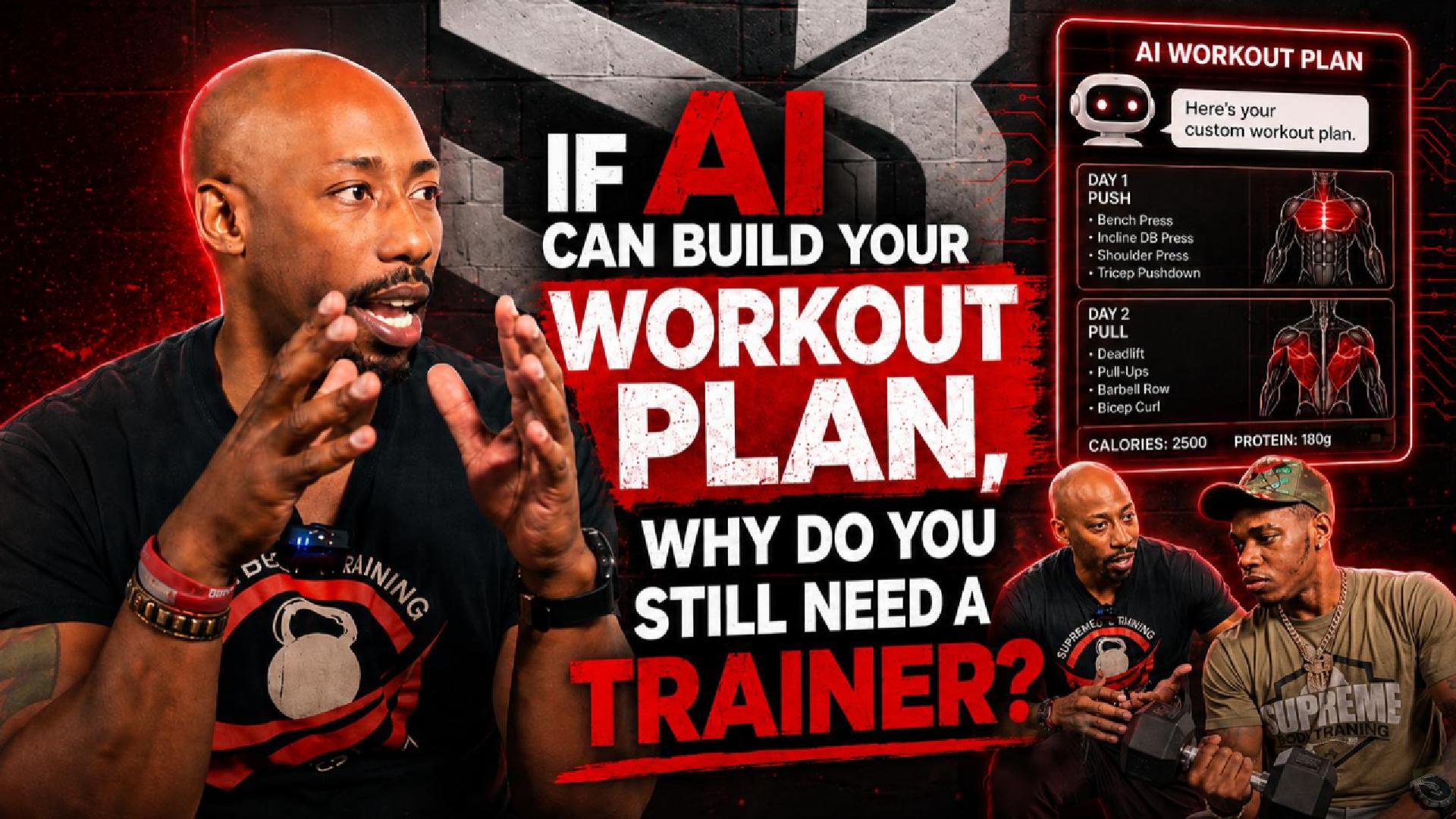
If AI Can Build Your Workout Plan, Why Do You Still Need a Trainer?
If AI Can Build Your Workout Plan, Why Do You Still Need a Trainer?
Artificial intelligence can create a workout programme in seconds.
You can ask AI for a three-day strength routine, a meal plan, exercise substitutions, calorie estimates, grocery lists, or even an entire 12-week fitness programme.
So if all that information is available instantly, why would anyone still need a personal trainer?
Because having a plan and successfully following a plan are two different things.
AI can provide information. A good trainer helps turn that information into consistent action by watching how you move, adjusting your programme, measuring your progress, providing accountability, and creating an environment that keeps you engaged.
AI may change fitness coaching, but that does not necessarily make human coaching irrelevant.
In many cases, the strongest approach may be using both.
AI Can Create a Workout, but That Does Not Mean It Is the Right Workout
AI-generated fitness programmes are improving quickly.
However, a programme generated from a prompt is only as useful as the information provided to the system.
Research evaluating AI-generated exercise prescriptions has found that AI can produce useful recommendations, but responses can also vary in accuracy, completeness, and individualization. One evaluation of GPT-4 exercise prescriptions found limitations when programmes were created from a single initial interaction, while a 2026 analysis of AI-generated marathon programmes found inconsistencies in areas such as pacing, weekly mileage, and differentiation between athlete levels.
A trainer working directly with you can see things that may not appear in your prompt.
For example:
How well you perform a squat
Whether an exercise causes discomfort
Whether one side is weaker than the other
Whether the weight is actually challenging you
Whether you are progressing or simply repeating workouts
Whether fatigue is affecting your technique
Whether the programme fits your real schedule
AI can suggest an exercise.
A qualified trainer can watch what happens when you perform that exercise.
That distinction matters.
Knowledge Is Not the Same as Implementation
Most people already know some of the basics.
They know they should exercise.
They know they should eat better.
They know they should move more.
They may even know exactly which exercises they want to perform.
But knowing what to do does not guarantee that it gets done.
Research describes an intention-behaviour gap in physical activity, meaning that wanting or planning to exercise does not always translate into actually performing the behaviour consistently.
This is where coaching can become valuable.
A trainer can help provide:
A scheduled training structure
Progression from week to week
Exercise modifications
Feedback
Accountability
Goal tracking
Encouragement during difficult periods
AI can remind you to exercise.
It cannot physically make you walk into the gym and complete the session.
Ultimately, implementation still belongs to you.
A Trainer Can Adjust the Plan in Real Time
A workout programme should not remain unchanged simply because it looked good when it was created.
Your body adapts.
You may become stronger.
An exercise may become too easy.
Your schedule may change.
You may experience discomfort.
Your goals may change.
A trainer can respond to those changes while they are happening.
If you are supposed to complete ten repetitions but could easily perform another fifteen, the resistance may need adjustment.
If your technique begins to break down after six repetitions, pushing blindly toward ten may not be appropriate.
If an exercise consistently creates pain rather than normal training discomfort, a qualified professional can modify the movement and, when necessary, recommend medical evaluation.
The programme should evolve with the person.
Community Is Something a Workout PDF Cannot Replace
Fitness is not only sets, repetitions, calories, and exercises.
For many people, community matters.
Training around people who are working toward similar goals can make exercise feel less isolating.
Community-based and peer-supported exercise programmes have shown potential to support participation and adherence, although individual results vary.
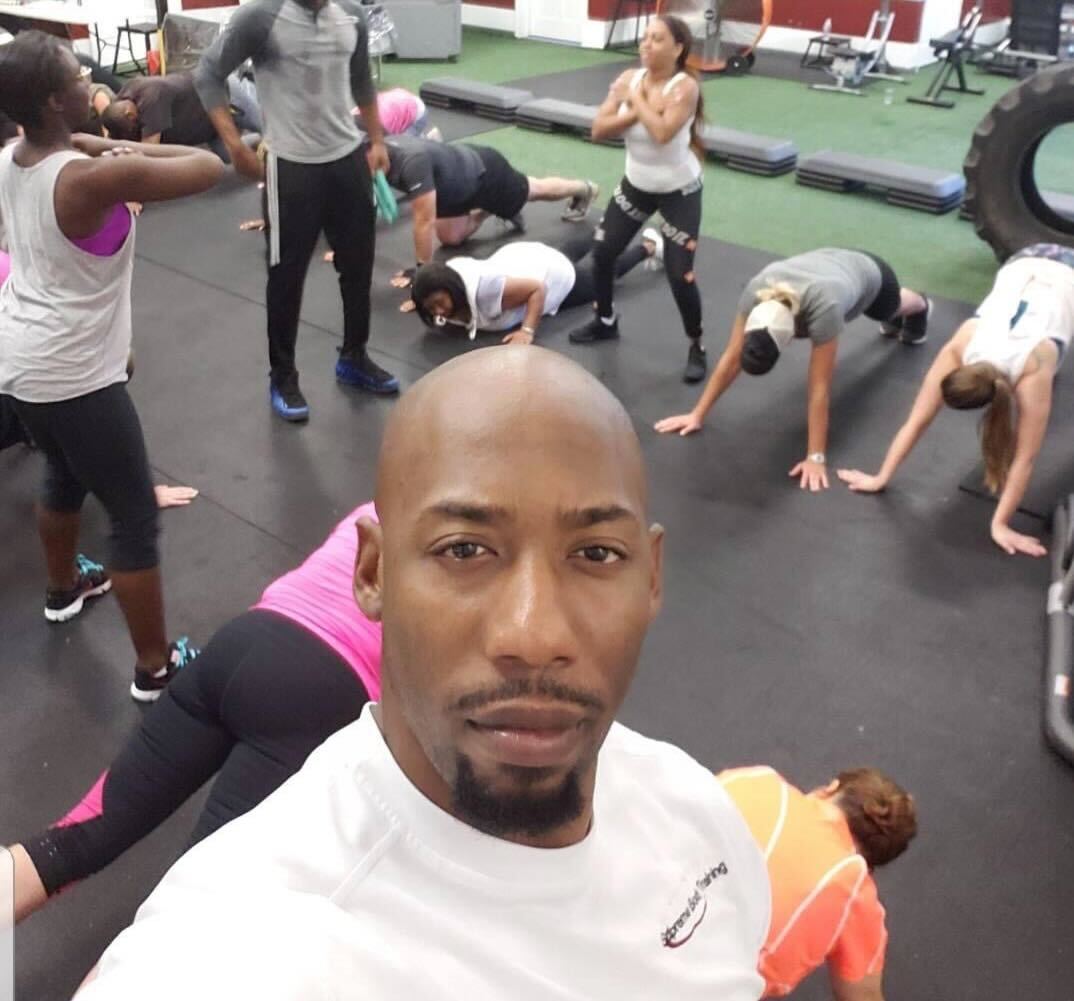
That human element is a major part of the Supreme Body Training approach.
Members are not simply handed a programme and sent into the gym alone.
They train around other people who understand the challenges of becoming healthier.
They celebrate progress together.
They recognize when someone has been missing.
They encourage one another during difficult workouts.
AI can simulate conversation.
It cannot fully reproduce the experience of walking into a gym where people know your name and expect to see you.
Supervision Can Make a Difference
Working with a trainer does not automatically guarantee better results.
The trainer still needs appropriate knowledge, the programme must be well designed, and the client has to participate consistently.
However, research has shown benefits from supervised training in some populations.
In one randomized study of health-club members, participants following a structured programme supervised by qualified personal trainers achieved greater improvements in lean body mass and several fitness measures than participants completing self-directed training over 12 weeks.
That does not mean everyone needs a trainer forever.
It does show why simply possessing workout information and receiving professional supervision are not necessarily the same experience.
Muscle and Fat Change How the Body Looks
Two people can weigh exactly the same and look completely different.
This is where focusing only on scale weight can become misleading.
A pound of muscle and a pound of fat both weigh one pound.
However, muscle tissue is denser, so the same weight of muscle generally occupies less space than the same weight of body fat.
That is why two 200-pound individuals can have dramatically different:
Waist measurements
Body-fat percentages
Strength levels
Muscle mass
Body shapes
Fitness levels
But we should be careful with extreme examples.
You cannot simply assume that one 200-pound woman contains 180 pounds of skeletal muscle and another contains 130 pounds based on appearance.
Body composition requires measurement, and even body-composition devices provide estimates rather than perfectly exact values.
Why Resistance Training Still Matters
For people trying to lose body fat, resistance training should be an important part of the conversation.
Research suggests that resistance training can help reduce the loss of lean mass during weight reduction while also improving strength.
Strength training may include:
Dumbbells
Barbells
Resistance machines
Resistance bands
Cable exercises
Bodyweight movements
Adults are generally encouraged to perform muscle-strengthening activities involving the major muscle groups at least two days each week, along with regular aerobic activity.
However, building muscle does not mean lifting the heaviest weight possible every session.
Progressive resistance can also involve adding repetitions, improving technique, increasing range of motion, adding sets, or gradually using more resistance.
The goal is consistent progression.
More Muscle Does Not Automatically Mean a “Fast Metabolism”
Muscle matters, but fitness marketing often exaggerates its effect on metabolism.
Having more lean tissue contributes to energy expenditure, and resistance training can support body composition.
However, it is inaccurate to say that someone who does not have enough muscle automatically has a slow metabolism or cannot reach their fat-loss goals.
Body weight and energy expenditure are influenced by many factors, including:
Total body size
Muscle and other lean tissue
Physical activity
Food intake
Age
Genetics
Sleep
Health conditions
Medications
Muscle is valuable because it supports strength, mobility, function, training performance, and healthy aging.
That is already a strong enough reason to build it without making exaggerated metabolism claims.
Weight-Loss Medication Is Not the Enemy Either
The original discussion describes pharmaceutical weight-loss treatments as a greater threat than AI.
That creates an unnecessary conflict between medical treatment and fitness.
Prescription weight-loss medications can be legitimate medical tools for appropriate patients.
For example, the FDA has approved semaglutide-based Wegovy for long-term weight management in certain people with obesity or overweight, alongside reduced-calorie nutrition and increased physical activity. It also has approved cardiovascular indications for qualifying patients.
Medication does not eliminate the value of exercise.
Exercise does not eliminate the potential value of medical treatment.
Someone using a prescribed weight-loss medication may still benefit from resistance training, adequate nutrition, daily movement, and professional guidance.
The better question is not:
Medication or exercise?
It is:
What combination of evidence-based strategies is appropriate for this individual?
Those decisions should involve qualified healthcare professionals when medication is involved.
Look Under the Hood With Body-Composition Tracking
The scale tells you how much you weigh.
It does not tell you exactly what that weight consists of.
At Supreme Body Training, body-composition tracking helps members look beyond one number.
A 3D Body Scan may help monitor changes such as:
Body measurements
Waist circumference
Body shape
Estimated body-fat percentage
Estimated fat mass
Estimated lean or fat-free mass
Changes between previous and current scans
This information can help create clearer goals.
Instead of saying:
“I just want to lose 30 pounds.”
The conversation becomes:
“Can we reduce body fat while maintaining or improving strength and lean tissue?”
That is a much more useful question.
Body-composition devices still provide estimates, so results should be monitored as trends rather than treated as perfectly exact measurements.
Building Muscle Takes Time
Another problem with fitness information online is unrealistic timelines.
There is no scientifically supported rule that the average person needs exactly 37 months to reach their ideal body composition.
There is also no reliable formula saying that everyone should add exactly 10 or 20 pounds of muscle.
Muscle development varies according to:
Age
Genetics
Sex
Training history
Nutrition
Programme quality
Recovery
Starting body composition
Consistency
Someone new to resistance training may experience noticeable improvements relatively quickly.
Someone who has trained seriously for several years may progress much more slowly.
Meaningful transformations often require months or years of consistent work, but assigning one exact timeline to everyone creates unrealistic expectations.
Where AI Fits Into Fitness
AI does not have to compete with trainers.
It can make good trainers more effective.
A fitness professional may use technology to help:
Organize programmes
Explain exercises
Create educational material
Track information
Generate meal ideas
Review training data
Improve communication with clients
The trainer can then spend more time on the areas where human involvement matters most:
Observation. Coaching. Adjustment. Accountability. Connection.
Technology has changed many industries without completely eliminating the professionals who use it.
Fitness may follow the same pattern.
The trainers who learn how to use AI effectively may become more capable, not less relevant.
A Message for the Supreme Warriors Community
You can ask AI to build you a workout.
You can watch thousands of free exercise videos.
You can download meal plans.
You can read about protein, calories, strength training, and fat loss all day.
Information has never been easier to find.
But information is only valuable when it becomes action.
A good trainer does more than tell you which exercises to perform.
They help you understand where you are starting, create structure, monitor your technique, adjust your training, measure your progress, and hold you accountable when motivation disappears.
And a strong fitness community gives you something an algorithm cannot completely reproduce:
People working beside you.
At Supreme Body Training, technology can support the programme, but people remain at the center of it.
The goal is not to compete with AI.
The goal is to use the best available tools while continuing to provide the coaching, accountability, strength training, and community that help members turn knowledge into results.
Ready to stop collecting fitness information and start implementing it?
Schedule your Supreme Body Training 3D Body Scan and speak with our team about building a structured programme around your body, your goals, and your current fitness level.
Important Corrections
The article does not claim that AI is incapable of creating useful fitness programmes. Research shows that AI can provide exercise guidance, but the accuracy and individualization of programmes can vary.
The claim that people without large amounts of muscle automatically have a slow metabolism was corrected. Muscle contributes to energy expenditure, but metabolism is influenced by many factors.
The statement that someone cannot reach their goals without adding large amounts of muscle was removed. Resistance training is valuable, but appropriate goals differ between individuals.
The example suggesting specific amounts of muscle and fat for two 200-pound women should not be interpreted as a recommended or typical body composition.
The claim that the average transformation requires exactly 37 months was removed because there is no universal timeline for muscle gain or body recomposition.
The article does not state that people must gain exactly 10 to 20 pounds of muscle. Appropriate muscle-gain goals depend on the individual.
Prescription weight-loss medications were not described as a threat or shortcut. They can be evidence-based medical treatments for appropriate patients and should be managed with qualified healthcare professionals.
Finally, knowing what to do and struggling to implement it are different problems. The purpose of coaching should be to provide structure and support, not to shame someone for previous weight-management difficulties.